
Put two meals side by side with the same calories, carbohydrate, fat, protein, fibre and salt, and you might expect the body to treat them much the same. A Virginia Tech crossover trial, published in Nature Metabolism on 5 October 2026, found otherwise. The ultra-processed meal triggered a much larger insulin response than the whole-food version, even though overall blood glucose barely differed.
It was a small, short study, so it cannot settle the argument on its own. What makes it interesting is the question it really aks: are the effects of ultra-processed food explained entirely by nutrients, or does the way the food is made matter too?
What the researchers did
Researchers in Alexandra DiFeliceantonio's lab at Virginia Tech prepared two meals of roughly 300 kcal. On paper, they were almost identical. The difference was that one meal consisted entirely of NOVA group 4 ultra-processed foods, while the other used foods from NOVA groups 1–3.
- Who: 57 healthy-weight adults enrolled, average age 26 and average BMI 22.8. 32 completed both metabolic sessions and 52 completed the brain-imaging session.
- Design: Randomised crossover. Each person ate both meals on separate mornings after an overnight fast, in random order, finishing within 10 minutes.
- Matching: Weight, energy, energy density, carbohydrate, fat, protein, fibre, sodium, water, glycaemic index and glycaemic load were all matched within 1.6%.
- Measures: Blood glucose and insulin over three hours, energy expenditure and fuel use, and fMRI brain scans while participants viewed and bid on food images.
The ultra-processed option included a peanut butter and jelly sandwich with vegetable chips. The whole-food option included foods such as banana and cheese.
What they found
Despite their near-identical nutrition profiles, the meals did not produce the same hormonal or metabolic response.
| Measure | Ultra-processed meal vs whole-food meal |
| Insulin (total over 3 hours) | Significantly higher (P < 0.001), elevated from 40 to 120 minutes |
| Blood glucose (total over 3 hours) | No meaningful difference (P = 0.92) |
| Energy expenditure | Higher (P = 0.02) |
| Fuel use | Less carbohydrate burned, more fat burned |
| Willingness to pay for foods | No difference (P = 0.34) |
| Brain value signals | Opposite direction for the two food types |
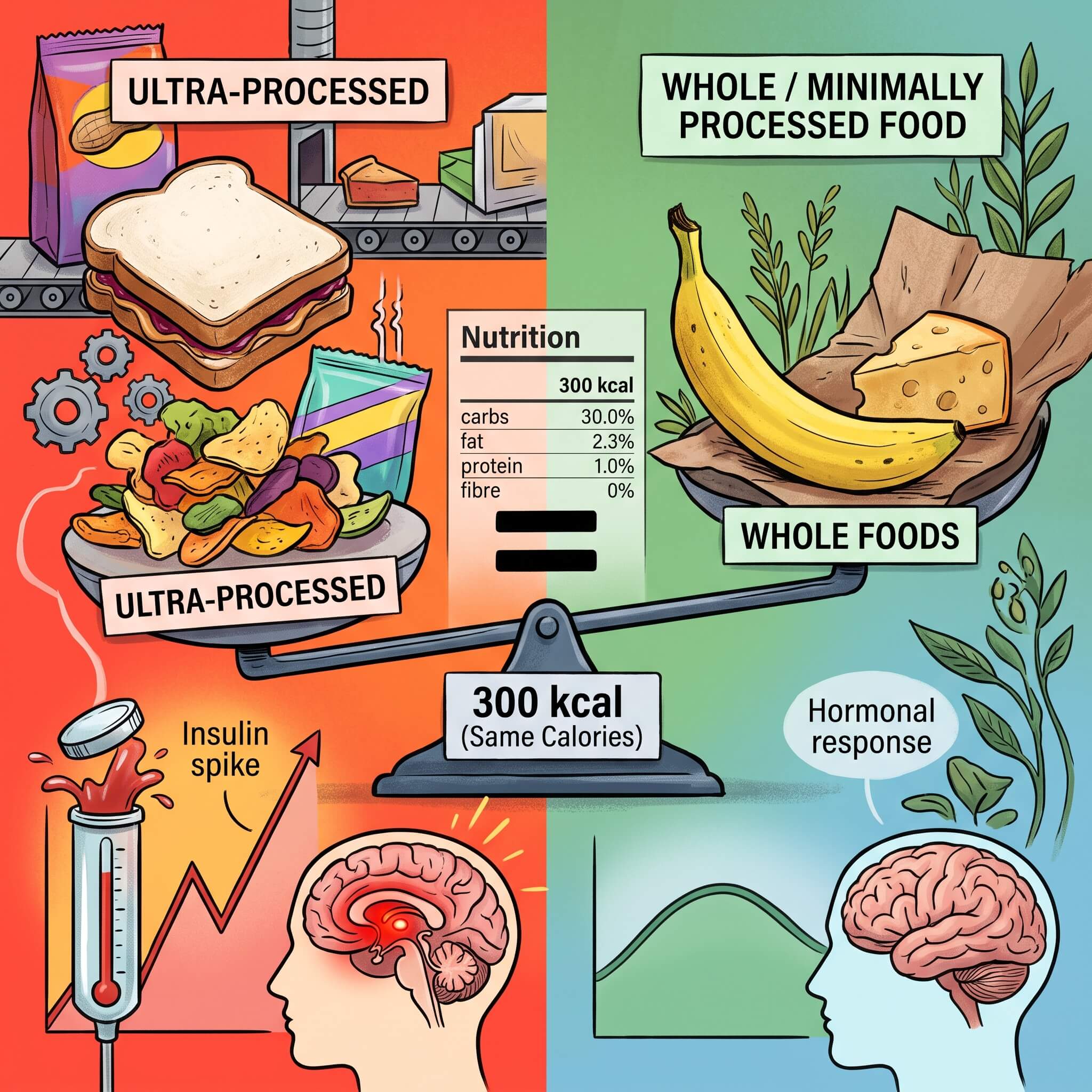
Two findings are worth lingering on. The first is that the body released more insulin after the ultra-processed meal, even though blood sugar over the full three hours was much the same. The second is the mismatch between what participants said and what appeared in their scans: they valued both food types similarly, but brain activity moved in opposite directions. In visual and reward-related regions, activity increased with the stated value of whole foods and decreased with the stated value of ultra-processed foods.
Changes in carbohydrate burning also tracked activity in the striatum, a region involved in reward and motivation. The researchers think this may mean the brain assigns value to ultra-processed and whole foods in different ways, although the study cannot show how that difference affects eating over time.
What it doesn't tell us
This was a tightly controlled mechanistic experiment, not a test of long-term health outcomes. Its limits are important:
- One small meal, once. About 300 kcal on a single morning. Larger meals and habitual diets may behave differently.
- Young, healthy-weight adults only. Results may differ in people with insulin resistance, type 2 diabetes or obesity.
- Protein sources differed between meals, which could itself affect insulin.
- Processing wasn't separated from ingredients. Additives and food structure weren't measured beyond fibre, so we can't say which part of "ultra-processing" drove the effect.
- Not blinded, and dropout was high: only 32 of 57 completed both metabolic sessions.
Nor does a higher insulin response to one meal automatically signal disease. Independent dietitians have cautioned against treating it that way. It is also worth remembering that NOVA sorts foods by the degree of processing, not by their overall nutritional quality.
Why it matters: beyond the nutrition panel
This study matters because it offers a possible mechanism for patterns already seen in large population studies. Its results suggest that processing may influence the body's response independently of familiar targets such as sugar, fat and salt.
- Population links are broad. A 2024 umbrella review in The BMJ covered almost 9.9 million people. Higher ultra-processed intake was associated with 32 of 45 health outcomes studied, including cardiovascular death and type 2 diabetes. These are associations, not proof of cause.
- Controlled feeding points the same way. In a 2019 NIH inpatient trial in Cell Metabolism, 20 adults ate about 500 kcal more per day on an ultra-processed diet. They gained about 0.9 kg in two weeks, even though meals were matched for nutrients.
- Australians eat a lot of it. National survey data analysed in BMJ Open found ultra-processed foods supplied 42% of Australians' energy intake (2011–12 data).
One possible explanation is the food matrix: the physical structure that holds a food's nutrients together. An intact banana, a whole grain and a piece of cheese are broken down differently from ingredients that have been refined, recombined and extruded. Matching two nutrition panels does not necessarily make the products biologically equivalent.
Implications for shoppers, brands and regulators
For shoppers, the nutrition panel still matters, but it does not tell the whole story. The ingredient list can give a rough sense of how far a product has travelled from its original ingredients. A short list of familiar foods often points to less processing, though it is not a perfect rule.
For health food brands, claims such as "high protein" or "low sugar" may no longer be enough. A bar can meet every macronutrient target and still be heavily processed. Products made from whole or minimally processed ingredients have a clearer point of difference, provided the story stays grounded in evidence. This small trial does not support claims that any particular product improves insulin control or metabolic health.
For Australian regulation, processing is now firmly on the agenda:
- In February 2026, food ministers moved to have FSANZ draft a proposal for mandatory Health Star Ratings. Voluntary uptake was about 37%, short of the 70% target.
- The current rating is based on nutrients, not processing. Public health experts want it to reflect ultra-processing, while some industry groups oppose this.
- The NHMRC is reviewing evidence on ultra-processed foods as part of updating the Australian Dietary Guidelines.
That is why findings like these are likely to feature in the debate: they point to effects that a nutrient-based rating may miss.
The takeaway
Calories and macronutrients are not the whole picture. In this trial, meals that looked almost identical on paper produced different insulin, fuel-use and brain responses. Processing was the clearest difference between them.
That does not prove that ultra-processed food causes long-term harm. The experiment was too small and too brief for that. Still, it sits comfortably beside a growing body of evidence favouring diets built mostly from whole and minimally processed foods. The next useful steps are larger trials, especially in people with metabolic conditions, and a close watch on whether Australia's Health Star Rating and dietary guidelines begin to account for processing.
References
- Hutelin Z, et al., DiFeliceantonio AG. Metabolic and neural responses to ultraprocessed foods: a randomized, controlled, crossover study. Nature Metabolism, 5 October 2026.
- Lane MM, et al. Ultra-processed food exposure and adverse health outcomes: umbrella review of epidemiological meta-analyses. The BMJ 2024;384:e077310.
- Hall KD, et al. Ultra-processed diets cause excess calorie intake and weight gain: an inpatient randomized controlled trial. Cell Metabolism, May 2019. (NIH summary)
- Machado PP, et al. Ultra-processed foods and recommended intake levels of nutrients linked to non-communicable diseases in Australia. BMJ Open 2019;9:e029544.
- Medical News Today. Ultra-processed vs whole foods: what's the metabolic impact? (independent expert commentary).
- ABC News. Food ministers move closer to mandating Health Star Ratings, 11 February 2026.