Cold Pressed Castor Oil: Why Temperature Matters
· @Scotty
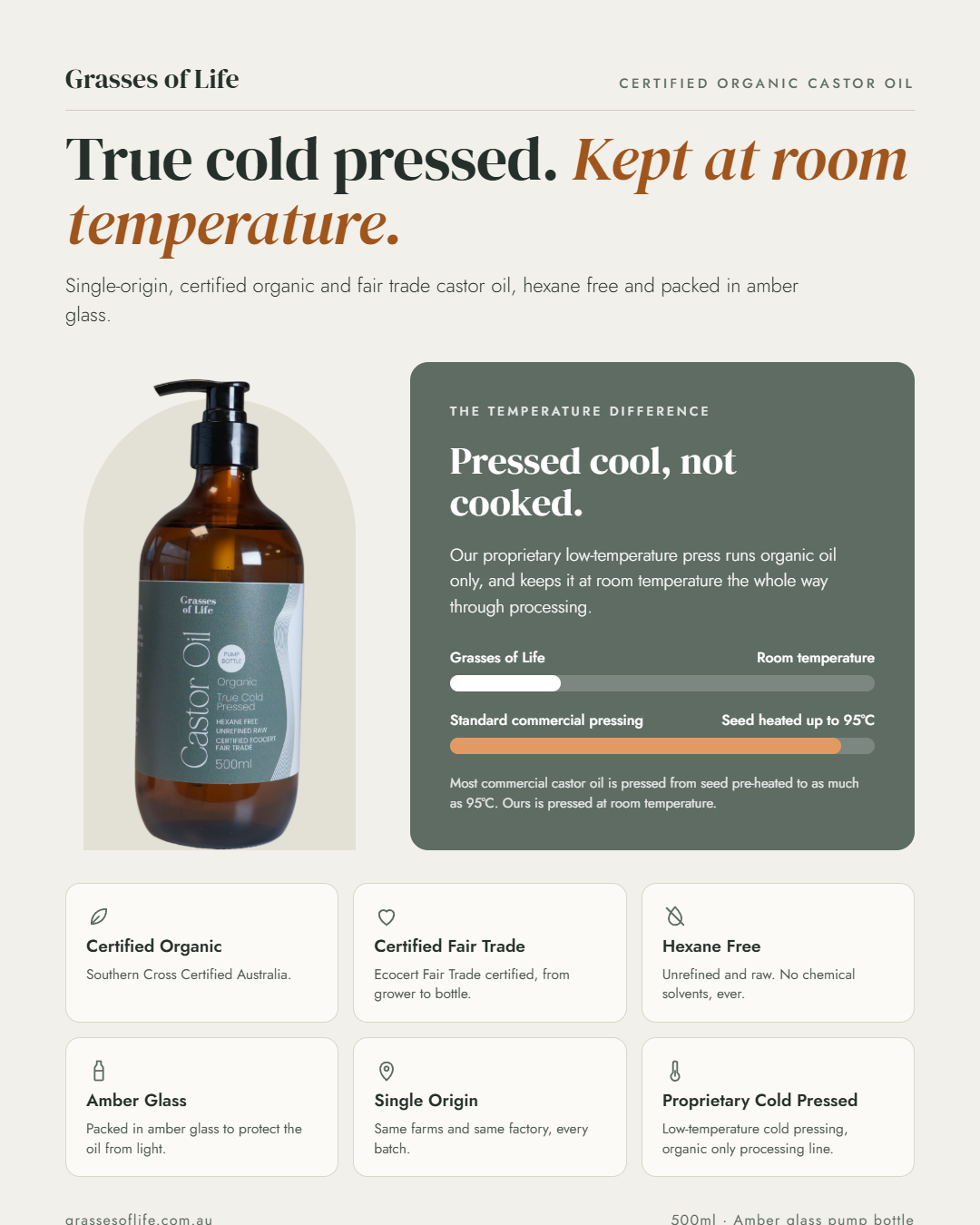
"Cold pressed" is printed on almost every bottle of castor oil, yet the term has no legal temperature limit. Most commercial castor oil is pressed from seed that has been pre-heated to as much as 95°C, according to a 2025 peer-reviewed review of castor oil extraction methods.
This article explains how castor oil is actually made, what the standards say about "cold pressed", what the research shows about heat and oil quality, and how Grasses of Life Organic Castor Oil is pressed at room temperature.
How most castor oil is made
Commercial castor oil production relies on heat. Avramovic and colleagues' 2025 review in Separation & Purification Reviews describes the standard steps: seeds are dehulled, cleaned, cooked and crushed before pressing (Avramovic et al., 2025).
- Pre-heating the seed. Commercial producers usually heat the seed in stack cookers before it enters the press. Cold pressing without pre-heating is used only to a limited extent, mainly in Brazil and India.
- Expeller (screw) pressing. In one industrial process described in the review, seed is dry-heated from room temperature to 95°C over an hour, then pre-pressed in an expeller.
- Solvent extraction. The leftover press cake is often washed with hexane at around 60°C to recover the remaining oil. The review notes the European Commission has called n-hexane a non-preferred solvent for edible oils.
Published screw-press studies run hotter again. One combined roaster and screw press heated castor seed to 83–119°C, and another screw press study tested 100–250°C.
What "cold pressed" actually means
There is no maximum temperature in the international definition of cold pressed oil. The Codex Alimentarius standard for named vegetable oils (CXS 210-1999) defines cold pressed oils as obtained by mechanical means without the application of heat. It sets no number (FAO, Codex CXS 210-1999).
That gap shows up in the research. Among the castor oil studies the 2025 review summarises, one process described as cold pressing ran at 60°C, while another was kept below 45°C (Avramovic et al., 2025). The same label covered a 15°C-plus difference.
The strictest legal benchmark we know of comes from olive oil. EU rules only allow "first cold pressing" or "cold extraction" on oil obtained below 27°C (Regulation (EU) No 29/2012, Article 5). There is no equivalent rule for castor oil.
Why heat matters
Heat raises yield, but it changes the oil. The 2025 review notes that pressing at elevated seed temperatures increases oil yield but may alter the oil's properties, and that screw presses use temperature control to preserve quality (Avramovic et al., 2025).
The studies it draws on show measurable differences:
- Viscosity drops when seed is pressed warm. Perdomo and colleagues pressed castor seed at room temperature and at 60°C. Oil pressed at 60°C had lower viscosity (Perdomo et al., 2013).
- Cold-pressed oil differs from solvent-extracted oil. Across the studies reviewed, cold-pressed castor oils generally had lower acid values and lower iodine values than solvent-extracted oils (Bekele et al., 2018; Ogunniyi, 2006). A lower acid value means fewer free fatty acids in the oil.
Viscosity is the thick, slow-pouring texture castor oil is known for, so a change there is something you can see in the bottle.
How Grasses of Life castor oil is made
Grasses of Life Organic Castor Oil is pressed at room temperature. It is made on a proprietary low-temperature press that runs organic oil only, and the oil stays at room temperature through processing.
|
What |
Detail |
|---|---|
|
Pressing |
Proprietary low-temperature cold press; oil kept at room temperature |
|
Organic |
Certified organic by Southern Cross Certified Australia |
|
Fair trade |
Ecocert Fair Trade certified |
|
Solvents |
Hexane free; unrefined and raw |
|
Origin |
Single origin: the same farms and the same factory for every batch |
|
Packaging |
Amber glass, which protects the oil from light |
Single origin matters for consistency. Seed from the same farms, pressed in the same factory, gives you the same oil from one bottle to the next.
How to choose a castor oil
Because "cold pressed" has no temperature limit, ask more of the label:
- Processing temperature. Does the brand say what temperature the oil reaches, or only "cold pressed"?
- Seed pre-heating. Is the seed cooked or heated before pressing?
- Solvents. Is it stated as hexane free?
- Certification. Is it certified organic by a named certifier, such as Southern Cross Certified Australia?
- Origin. Is it single origin, or blended from several sources?
- Packaging. Is it in amber glass rather than clear glass or plastic?
References
Peer-reviewed
- Avramovic, J. M., et al. (2025). Castor oil extraction: methods and impacts. Separation & Purification Reviews, 54(1), 60–82. doi:10.1080/15422119.2024.2361674
- Perdomo, F. A., et al. (2013). Physicochemical characterization of seven Mexican Ricinus communis L. seeds & oil contents. Biomass and Bioenergy, 48, 17–24. doi:10.1016/j.biombioe.2012.10.020
- Bekele, B. A., et al. (2018). Studies on Ethiopian castor seed (Ricinus communis L.): extraction and characterization of seed oil. Journal of Natural Product and Resources, 4(2), 188–190. doi:10.30799/jnpr.064.18040204
- Ogunniyi, D. S. (2006). Castor oil: a vital industrial raw material. Bioresource Technology, 97, 1086–1091. doi:10.1016/j.biortech.2005.03.028
Standards and regulations
- Codex Alimentarius. Standard for Named Vegetable Oils (CXS 210-1999). FAO
- Commission Implementing Regulation (EU) No 29/2012 on marketing standards for olive oil, Article 5. legislation.gov.uk